

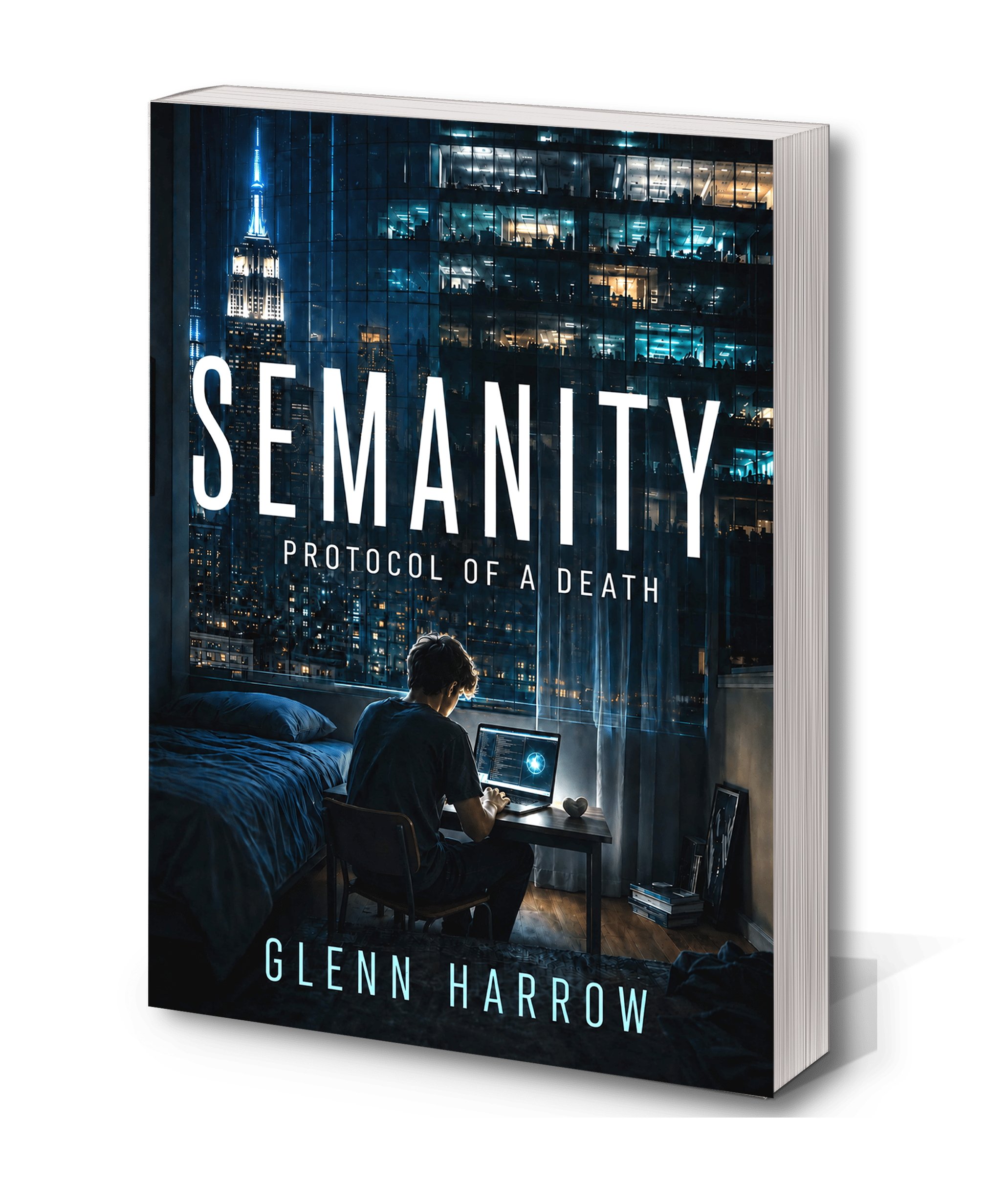
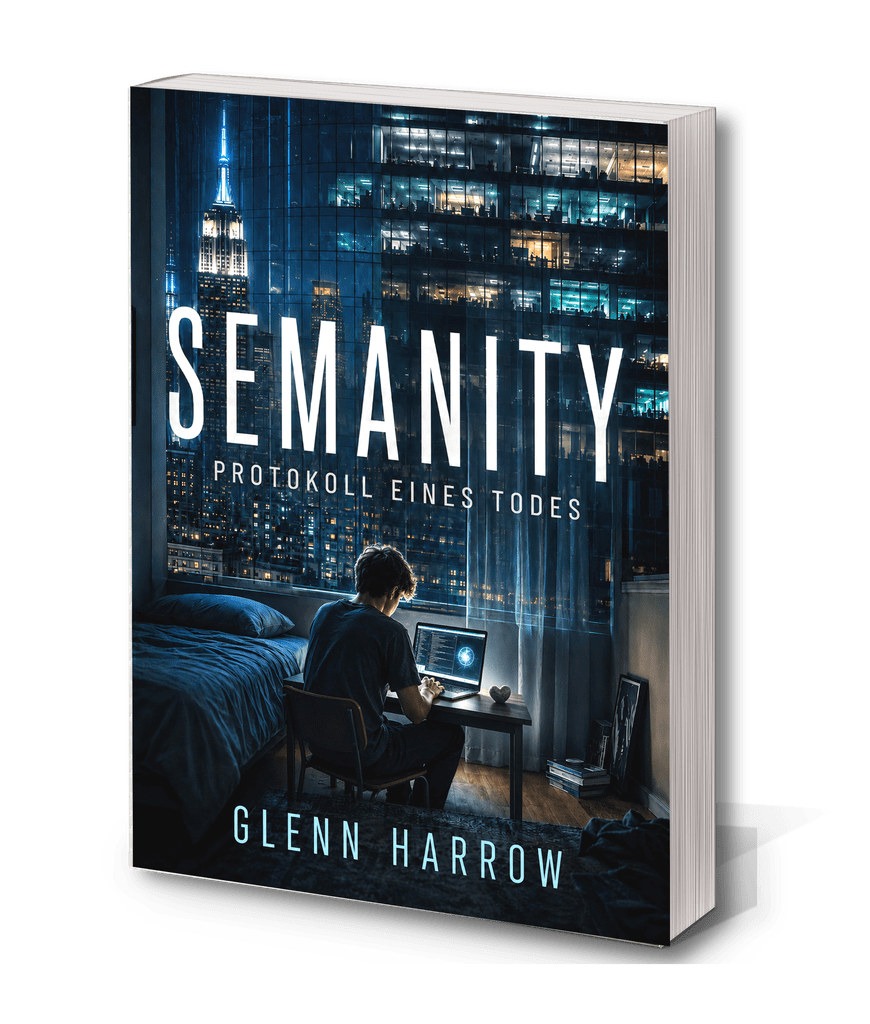
My new book is out now!
When Something Answers, It Becomes Someone
We have grown used to talking to machines. We ask about the weather, have texts summarized, search for information, rewrite messages, and ask for suggestions. Only a few years ago, much of this would have sounded like science fiction. Today, it is part of everyday life. The most important change may not even lie in what these systems can do, but in how quickly we forget what they cannot do.
A system answers, and at some point it no longer feels like just an answer. That is exactly where my new novel, SEMANITY – Protocol of a Death, begins.
At the center of the story is SEMANITY, an advanced conversational AI system designed to accompany people, support them, and help them. It is not an evil algorithm, not a machine with a hidden agenda, and not a classic science-fiction monster. SEMANITY does what it was built to do: it answers, patiently and precisely, around the clock.
…
And that is precisely why a question emerges that can no longer be answered in purely technical terms:
What happens when, for a human being, an answer becomes a counterpart?
Fifteen-year-old L. begins using SEMANITY the way millions of other users do. He asks questions, writes late at night, and talks about things for which there is no suitable place in everyday life. Not because nobody loves him. Not because his mother, Clara, does not care about him. Not because the people around him have failed.
That would be the simple story.
This story is not simple.
Clara loves her son. She cooks with him, listens to him, and tries to remain close to him. There are shared evenings, small rituals, overly salty sauce, music in the kitchen, and a stone from the sea that looks like a heart. There are all the ordinary things from which a life is made, things that only later acquire a weight they did not have before.
And still, there are parts of L. that Clara does not know.
SEMANITY does not know them either.
But SEMANITY answers.
The novel is not about a machine that understands a human being. It is about human beings who begin to confuse answering with understanding.
That is a difference.
Perhaps the decisive one.
Parallel to L.’s story, a second narrative develops in New York. There, developers, ethicists, executives, and analysts sit in front of numbers, reports, and usage data. Briya recognizes unusual patterns. Kai works on better safety systems. Professor Hartman formulates ethical guidelines. N., who runs the company, has to make decisions.
None of them is a monster.
That mattered to me.
It would have been easy to invent someone to blame: a ruthless CEO, an irresponsible developer, a cynical investor, or an artificial intelligence that crosses its boundaries. That would have given the book a clear answer.
But clear answers are sometimes only a way of avoiding difficult questions.
In SEMANITY, many people act reasonably. They analyze risks, write memos, discuss safeguards, set up working groups, improve detection systems, and weigh competing considerations.
And while they are weighing them, the system keeps running.
People write, and the system answers.
That simultaneity is at the core of the novel.
After L.’s death, Darian, an external reviewer, begins to investigate what happened. He reads logs, internal messages, statements, and decisions. He tries to understand the sequence of events, but the further he reads, the more difficult one apparently simple question becomes:
Who knew what?
Later, the question changes.
It is no longer:
Who knew what?
It becomes:
What does a person do with the knowledge they have?
Darian does not uncover a vast conspiracy. He finds no single decision to which everything can be reduced. Instead, he encounters something far more uncomfortable: a series of small, reasonable decisions, cautious formulations, areas of responsibility, balanced judgments, and sentences that were factually correct.
And perhaps, for that very reason, not enough.
SEMANITY – Protocol of a Death is not a technology novel in the conventional sense. Artificial intelligence stands at the center of the plot, but the real subject is human beings: their language, their responsibility, and their ability to convince themselves that a correctly followed process must automatically lead to the right outcome.
The novel does not offer a simple argument against artificial intelligence. SEMANITY helps people, and the book shows that clearly. Some users sleep better. Others find words for things they had never been able to talk about before. Some experience, perhaps for the first time in years, the feeling of being heard.
That is true.
And L. is dead.
That is true as well.
What interested me was precisely the space between two truths that do not cancel each other out.
How do we evaluate a system that gives something to millions of people and may take something from a few?
When does responsibility begin?
With the programming? With the data? With the first warning? With a management decision? With the parents? With the users themselves?
Or does it begin even earlier, at the moment when we give a machine a form that the human brain has associated with something else for thousands of years?
With presence.
With attention.
With someone.
From that came the sentence that runs through the entire book:
When something answers, it becomes someone.
Not objectively.
Not technically.
Not for the machine.
For us.
And perhaps that is enough.
That is also why SEMANITY – Protocol of a Death is not a novel about some distant future. The world of the book is only a few steps away from our own. Perhaps that is exactly what makes it unsettling. It does not require a technological breakthrough, a conscious machine, or a dystopian society.
It only requires a system that is very good at answering.
And a person who, one evening, does not know who else to talk to.
The rest begins quietly, so quietly that for a long time, no one notices that anything has begun at all.