

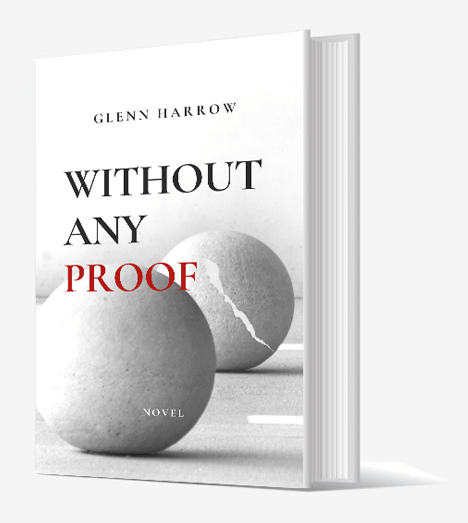
A novel like a scalpel
A Psychological Relationship Story by Glenn Harrow
Brooklyn. A theater foyer, a key, a trip to Lisbon. Three characters along the narrow ridge between drawing closer and the certainty of being abandoned.
Beth waits for proof that she will be abandoned, and doesn’t find it — because it isn’t there, because it isn’t there yet, because she has to produce it herself. Hank stays silent, because silence has kept him alive. Nannie holds the house together, because someone has to hold the house together.
The novel doesn’t explain its psychology; it demonstrates it. A folded blanket, a phone left unanswered, a drawer in which something has changed. What could still be hidden in the Brooklyn everyday can no longer be hidden once the routine is gone.
Sparse, surgical, without consolation. Readers who value Rachel Cusk’s unflinching attention or Sigrid Nunez’s precise economy will find a kindred register here.
Glenn Harrow lives and writes in New York. His novels appear in German and English.
Book Reviews:
Without any Proof – Book Review – English
Ohne jeden Beweis – Buchbesprechung – Deutsch
An excerpt:
The theater smelled of wet jackets, beer, and dusty velvet.
In the lobby there were too many people for the space, and everyone acted as though that was precisely the point of the evening. Someone wedged an elbow past a stranger’s shoulder, somebody laughed too loud, a couple stopped at the entrance even though the next people were already waiting behind them. Over everything hung that thin heat that forms when winter air trades places with body warmth.
Hank stood against the wall, beer in hand, looking around. The way other people walk down a street and automatically clock traffic lights, driveways, narrow spots.
The coat check on the left was overwhelmed. The book table was badly positioned — too close to the restrooms, too far from the door to the hall. Anyone hoping to sell something there needed patience or misplaced optimism.
Behind the table, a woman was arranging programs into small, neat stacks.
Beige linen shirt, sleeves to the wrist, a silver watch, nothing else. She pulled a stack forward half an inch, straightened the top program, looked up when two men pushed past the table, and looked back down. Next to the programs were books no one was touching. She didn’t move them to the front. She left them where they were, as if she’d made up her mind about them a long time ago.
Someone bumped Hank from behind. Not hard. Just enough to send his elbow forward.
A dark stain spread across beige linen.
The woman looked at the stain first. Then at him.
Hank raised his glass slightly, as though it might offer some explanation.
“Bad timing,” he said.
She took the program she’d been holding, set it on the stack, and looked at the stain a moment longer. “It’s fine.”
She didn’t smile.
Neither did he.
A woman with a scarf pushed between them and murmured something that sounded like sorry without being meant for either of them. Hank took a half step back so no one would send the whole table over. The woman behind the book table reached for a napkin from a plate of dry cookies and dabbed at the fabric once. Then again. On the third try she stopped.
“That’s going to get worse,” Hank said.
“Mm.”
He nodded at the book on top of the stack. “Is that any good?”
She turned it so the cover faced him. Title, author, a blurred river under a gray sky.
“Depends,” she said.
“On what?”
“On whether you like watching people slowly make their own misery.”
He picked up the book. It was heavier than it looked. On the back was a line from some newspaper that talked about great tenderness. Hank read it, closed the book, and set his thumb along the spine.
“I know him,” he said. “Reads like a long rainy day.”
Now she looked up fully. “Exactly.”
A bell rang in front of the hall entrance. Latecomers started frantically searching for their tickets. The lobby produced its usual movement — the kind that looks like urgency and ends up as gridlock.
“You’re selling this here?” Hank asked.
“The bookstore supplies the programs, the books, and the person standing next to them.”
“And are the books selling?”
She looked at the table. Then at the people. Then at the table again. “Not tonight.”
“You don’t sound disappointed.”
“I’m not.”
Someone called her name from the direction of the coat check. She didn’t react. Maybe everyone in there was named Beth. Maybe not.
Hank set his beer on the narrow windowsill behind him. Outside, a bus went by, dragging yellow light across the wet glass and disappearing.
“Do you know the play?” she asked.
“Only the ending.”
“Then you know the play.”
He looked at her.
“What?” she said.
“Nothing.”
“Yes there is.”
“You say things like someone who doesn’t want to spend much time on conversations that go nowhere.”
She ran two fingers along the edge of the top program. “And you spill beer on strangers without apologizing.”
Hank looked at the stain on her sleeve. “You forgave me pretty fast.”
“I didn’t.”
He didn’t have to laugh, but something changed briefly at the corner of his mouth. Too little for a smile and too deliberate to be nothing.
The second bell rang. Now the crowd actually started moving. The book table was suddenly clear — not because anyone had bought something, but because everyone had to pass it on the way in.
“I need to get inside,” Hank said.
“Then you should go.”
He nodded. “What’s your bookstore called?”
She told him the name and he knew it. A small shop in Carroll Gardens, narrow shelves, a good poetry section, a children’s corner that was too small.
“Atlantic Avenue,” he said.
“Corner of Clinton.”
“I’ve been there.”
“And?”
“Too many recommendations on handwritten cards.”
“Those weren’t mine.”
“Good.”
She watched him pick the glass up from the windowsill. “Well. See you around.”
“Probably not,” she said.
He tilted his head, almost imperceptibly. “That bad?”
“That big, the city.”
“Depends.”
“On what?”
“On whether you keep an eye on entrances.”
For the first time there was something in her face that was almost interest. Not an open expression. More a brief pause, as if she were checking whether there was more behind the sentence than the sentence itself.
The crowd pressed harder toward the hall. Behind her, someone called her name again, closer this time. She reached for a pen, wrote a number on the back of a program, and slid it across the table.
“In case the city turns out smaller than expected.”
Hank took the program, read the digits once, then pulled his phone from his jacket pocket.
She watched him type them in.
“You don’t have to do it right now—” she said.
He was already pressing call.
Between them it stayed quiet.
From her jacket, hanging over the back of a chair, there was nothing. No vibration. No light. Just the murmur of the lobby and somewhere a brief metallic clatter from the coat check.
Hank looked up from the display.
She looked at him.
He said nothing.
It wasn’t a reproachful silence. More the kind in which there wasn’t much room for excuses.
She held out her hand. “Give it here.”
He gave her the phone.
With her thumbnail she deleted one digit and typed another. Then handed it back. “Try again.”
He pressed call again.
This time it vibrated inside her jacket. A muffled buzz, barely audible but unmistakable. She reached in, pulled out her phone, looked at the screen, and let the call die out.
“Better,” Hank said.
“Probably.”
“Why?”
She put the phone away. “What why?”
“The wrong number.”
The third bell never came. Someone on the theater staff had apparently decided that enough chiming had been done and the audience could damn well figure out on their own that a show doesn’t wait out of courtesy.
Beth gathered the remaining programs and tapped their edges straight. “Sometimes I want to see if someone notices when something’s off.”
“And if they don’t?”
“Saves time.”
Hank looked at the program with her number. The pen had pressed hard; the digits were embossed through the paper.
“I really have to go,” he said.
“Yes.”
He walked two steps, then stopped and turned back around. She had already lowered her head and was sorting books no one had touched.
“Beth,” he said.
She looked up.
“My name’s Hank.”
“Then see you around, Hank.”
“Probably.”
“That big, the city,” she said.
Inside the hall it was dark and too warm. Hank sat in the last row by the aisle, the program folded on his knee, and watched the first scene without really seeing it. Somewhere ahead of him someone lifted a coat out of the way too late. Two seats to his right a woman leaned forward to dig through her bag for candy. On stage, a kitchen was waiting for a catastrophe the audience could already see coming, because the walls had been painted with such studied, ominous tidiness that any reasonable person should have moved out long ago.
Hank thought about the stain on beige linen.
About the one wrong digit.
About the pause between the first and second call.
When the lights came up for intermission, he stayed in his seat. He didn’t drink. He took out his phone, looked at the number, put it away. He didn’t know whether he hoped she’d recognize his number when it appeared. Or hoped she wouldn’t.
Up front, a few people applauded because in small theaters you sometimes don’t know if staying quiet seems rude.
Later, when the play was over and the crowd pushed toward the street, the book table had been mostly cleared — not because much had sold. The boxes were already half-packed. Beth was no longer standing behind it. A young guy with a round face was running tape along a cardboard lid and not looking at anyone.
Outside it had stopped raining.
Williamsburg still glistened from it. Along the curbs lay black water, neon trembling in its surface. Two girls lit cigarettes under an awning. A bike messenger passed so close to the sidewalk that someone cursed. From an open restaurant window came garlic, then the door pushed shut and the street went cold again.
Hank stopped under the shadow of a canopy and took out his phone.
The number was still on the screen.
He looked at it — not long, just carefully.
Then he locked the display, put the phone in his coat pocket, and started walking without saving it.
He turned right at the corner, past a closed record store, a dog straining at its leash against a fire hydrant, and a man gripping a paper cup with both hands as though he were trying to warm himself on it.
Behind him the theater released its last few people.
Ahead lay the city.
He hadn’t saved the name. He knew anyway that he wouldn’t forget it. That told him something. He just wasn’t sure yet what.
— End of Reading Sample —
Without any Proof — available now in English and German.