The Psychology of Expectation
Harrow writes about Beth with a matter-of-factness that takes no sides – and is disturbing for exactly that reason. Beth is not a villain. She’s not a manipulator in the sense that immediately smells of malice. She is a woman who learned early – through a father who sent birthday cards a day late; through a former partner who quietly disappeared through a door; through a birth that shouldn’t have worked and then did – that closeness is not a stable condition. That when you love someone, you are really just waiting. For it to end.
Harrow never names this mechanism. There’s no psychological explanation, no passage where a therapist delivers the diagnosis. Instead, the novel shows Beth lying in bed each morning, counting her partner’s breaths before she opens her eyes. How the counting takes seconds at first, then longer. How she catches herself doing it and can’t stop anyway. The body already knows the story; the mind just wants a little more time to pretend it’s still open.
That is precise literary craft. It is also psychologically uncomfortable in the most accurate way.
Hank: Stoicism as Fate
On the other side stands Hank. Props manager at the Belasco Theatre, one of those men who constantly scan their surroundings for exits and yet fail to notice when a door has long since closed. He is not a bad guy. Even the test readers on Harrow’s website make that point, and they’re right: “Hank is not a monster. That’s the worst part of it.”
What Hank has is a capacity for stillness that looks like strength for a long time and eventually looks like failure. He drinks – but not dramatically. Not in the way you immediately recognize and name. He drinks the way people carry a habit that only stops working when it’s too late to notice. A beer after rehearsal. Another bourbon once Eddie’s gone. The hours stretch longer, the walks home get longer, the pauses before answering simple questions grow by half a second. No collapse. No spectacle. Just the slow erosion of something.
Harrow describes Hank through his hands. That’s not an accident. The right hand that presses against a doorframe because air doesn’t offer enough resistance. The hands in the props room, holding objects and briefly forgetting what they’re for. There is one sentence about Hank’s right hand near the end of the novel – so short you almost miss it. You won’t stop thinking about it after.
Jan as Instrument
Between Hank and Beth steps Jan. A man from the running club, an accountant, punctual, fully present, no phone face-up on the table. Jan is the counterimage of what Hank has become: someone who listens without immediately responding. Someone who doesn’t build a frame around Beth’s sentences so she can feel safe inside them – but lets them stand, complete, without correction.
Harrow is smart enough not to give Jan any real depth. This is not a weakness of the novel; it’s its intention. Jan is, as the last sentence about him puts it, “never a place. Just a mirror.” A projection surface for what Beth needs in order to complete a story that has lived in her far longer than Hank has.
Reading Jan as an instrument rather than a rival is one of the novel’s bravest moves. It refuses the cheap love triangle. Instead, it makes something more unsettling visible: that Beth isn’t really going toward Jan, but away from Hank. And that this is not a moral indictment – just a very human mechanism.
The Evening Everything Has Been Building Toward
There is an evening in the final third of the novel that Harrow has been steering toward since page one – without your being able to say exactly when you knew it. That evening, Beth cleans the apartment. More thoroughly than necessary. Paul’s blanket gets folded, the table cleared, the child taken elsewhere. Harrow writes that the apartment looks like “a room just before a scene, where all the objects already know they will be witnesses.” That is not a neutral sentence. That is Beth.
What happens in that kitchen is something you should discover for yourself. Not because it’s dramatic – Harrow explicitly refuses the dramatic – but because the real shock lies not in the event itself, but in what it triggers in Beth. Or more precisely: what it confirms.
The case has been closed.
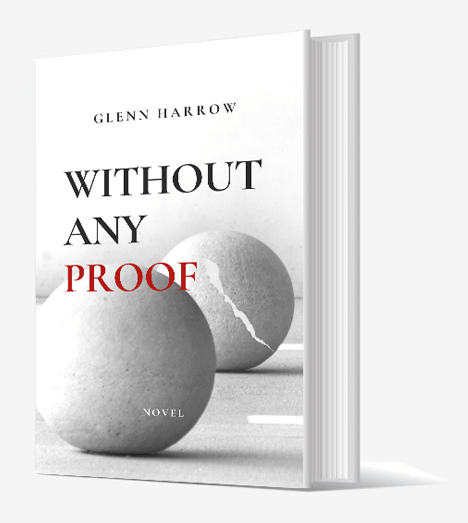
That is the heart of the novel and the reason the title lands so precisely. Without Any Proof – that is the condition Beth lives in at the start. Doubting, counting, waiting. By the end of the book, that condition is over. What lies between is neither a love story nor a thriller. It is the reconstruction of an inner logic, carried out so carefully and so relentlessly that at some point you stop asking who’s right, because you realize that question was never the right one.
What the Novel Wants and What It Earns
Harrow is not a writer for readers who want to know, after the final chapter, who was right. Nor is he a writer who converts his characters’ discomfort into a message. Without Any Proof doesn’t tell a story that can be translated into a social argument. It tells how a relationship is ground down under the weight of two damaged psychologies – slowly, without spectacle, with a logic that accounts for both sides without letting either of them off the hook.
Stylistically, Harrow is on the side of precision. Short sentences that don’t want to sound cool – they want to cut something off. Conversations where the silences carry more than the words. A prose that never explains what it shows. That is technically impressive – and sometimes merciless, because the reader gets no guidance. You have to do the work yourself.
That is the burden and the promise of this book.
Glenn Harrow allows no redemption because the lives of his characters don’t prepare any. The child’s bedroom in Carroll Gardens lies in the dark. Hank stands in the props room at the Belasco, holding objects, as if their shape might tell him what to do with a past that can’t be put away. And Beth – Beth is standing somewhere, looking in a mirror, and what she’s thinking, the novel does not reveal.
If you want a novel that gives its characters something at the end, this is the wrong book. If you want a novel that keeps working long after the last page – until you eventually realize you’ve been in it all along – this is exactly the right one.
E.Crowl, a New York author